|
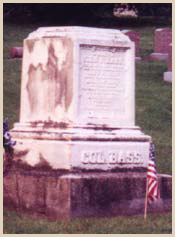
Colonel Sion S. Bass
Colonel
Bass was born in Salem, Kentucky, on January 6, 1827. He was descended
from a line of early setters in Virginia, the Carolinas, and Kentucky.
In 1805, at the age of three, Sion's rather had been taken by his
parents from Virginia to the wilderness of Christian County, Kentucky.
Sion's mother, Jane Todd Bass, who had come with her family from
Charleston, South Carolina, was also an early pioneer in the Bluegrass
country. In Kentucky Sion's father acquired large areas of farmland
and became prominent in local affairs. After
his gradation in February 1849, Sion followed his mother's advice
and came to Fort Wayne. Jane Bass believed that Fort Wayne, already
a thriving town, would offer good business opportunities for her
sons because of its favorable location at the confluence of the
three rivers. Chicago, she believed, would soon grow too large.
In Fort Wayne, Sion found employment with the great western fur
traders, Ewing, Chute, and Company, and soon became a trusted confidential
agent of the firm. In this position, he became acquainted at first
hand with the dangers sad privations of frontier life. In
1853 Sion became a member of Jones, Bass, and Company, which manufactured
iron products. In 1857 the firm was sold to the Pittsburgh, Fort
Wayne, and Chicago Railroad. In September of the same year Sion
Bass formed a partnership with William H. Jones. The partners established
a new foundry and machine shop along the Pittsburgh, Fort Wayne,
and Chicago Railroad and the Wabash Railroad. In 1858 a partnership,
which had been formed by Edward Force and Sion's brother John, leased
the plant. And the following year the plant was sold to the Fort
Wayne Machine Works. The activities of Sion Bass cannot be traced
from the completion of the sale negotiations until the onset of
the War Between the States. On
September 12, 1861, Sion Bass received his appointment as colonel
of the Thirtieth Regiment of Indiana Volunteers, which was then
being recruited. By September 24, the quota for the regiment had
been filled, and the Thirtieth was organized at Camp Allen in Fort
Wayne. Although he was himself untrained for military service, Colonel
Bass entered upon the task of disciplining and training his raw
recruits with such energy and devotion to duty that he soon won
the praise of his superior officers. The
unit was then ordered to proceed to Kentucky. On October 13, 1861,
the regiment was assigned to the Fifth Brigade, Second Division
in General Don Carlos Buell's Army of the Ohio. For the next few
months Colonel Bass and his Thirtieth Indiana Regiment marched with
Buell's army but saw little action. Salem, Lexington County, Kentucky November 29, 1861 It is with great pleasure I write you hoping to hear from you soon, as I have not heard from you in months. I know not where your brother is. I hope he is not in Columbus. We hear the firing of cannons every day at Cairo, Columbus, Belmont, and several other places. We have had no FORT WAYNE TIMES for two weeks till yesterday. It gave an account of his being in Nevin, about the center of the state, where I think he will be killed. John, could you have no influence over him? Why did he go? What will become of his little children? Buckner and he will come in contact with eachother soon, and what will be the event? God only knows. I never expect to see him again. Richard M. Ford was killed in the Battle of Belmont, six miles from Columbus. I expect his wife is in Texas. Ford Sterling was killed at Bowling Green. Mr. Pippen died the nineteenth of November, and you heard of the death of Mr. Barker. Beverly was here yesterday and says they are all well. Every person has left Salem except for a few families. Your Pa says, "I have done nothing in no way"; and he expects to stay at his home and do the best he can. All the ferryboats are sunk, and there is no way to cross the river. The troops pass through Salem -- the Northerners and the Southerners. I am afraid of their meeting sometime in Salem. I expect the mail will stop. Give my respects to Eliza and the children, and write often. Let me hear from your brother if you ever hear again. I close by saying, Your ever affectionate mother, Jane
Bass Suddenly,
the Colonel's horse was wounded and became almost unmanageable.
Colonel Bass dismounted to examine the wound. Just as he reached
the ground, he was struck in the upper thigh by a musket ball. Nevertheless,
he soothed his horse, remounted, and continued to fight. He rode
calmly among his men and exhorted them to still greater efforts.
But soon he became faint and could no longer sit in the saddle.
The wound was mortal one, but death did not come immediately. Colonel
Bass was carried from the battlefield to a Tennessee River steamer
and transported to Paducah, Kentucky. He passed away at St. Mark's
Hospital in that city a week after he had been wounded. His wife,
mother, and brother were present at his bedside. "RESOLVED, that while the remains are passing from the cars to his late residence, and during the funeral ceremonies of the lamented Colonel Bass, this meeting requests that all secular business be suspended, that the bells of the city be tolled, that the flags be hung at half-mast, and that the business hours of the city be closed during the funeral obsequies." Another
committee was appointed to draft resolutions expressing the loss
sustained by the country and the community in the death of Colonel
Bass. On April 21,1862, these resolutions were published in DAWSON'S
DAILY TIMES AND UNION: "RESOLVED, That our grief for the death of Colonel Bass is aggravated by the reflection that perhaps he and thousands of other Federal soldiers who were slain or wounded in the Battle of Pittsburg Landing might today be standing with their arms in their hands. They might still be ready to do battle in their country's cause had it not been for the apparently inexcusable and unparalleled neglect of the commanding generals in not using those precautions against a 'surprise' which are always used by trustworthy commanders at the head of armies in the presence of active and powerful foes. Courage is only one qualification for a commander; to personal bravery there should be united military science and skill, vigilance, prudence, and self-control. Whenever it shall be discovered that any general in command of Federal forces is deficient in those indispensable qualifications, it is the imperative duty of the Administration to relieve him of his command. "RESOLVED, That, as Indiana has given without stint her noble and cherished sons to the nation to aid in crushing a monstrous and causeless rebellion, and as their blood has been freely shed on nearly every battlefield where success has attended the Federal arms, she has a right to demand and will demand that those who are still at their posts shall not unnecessarily sacrificed through the imcompetency or carelessness of commanding generals. "RESOLVED, That the citizens of this county, while they mourn over the untimely death of Colonel Bass, have the proud satisfaction of knowing that, although he was born and raised in a state of doubtful loyalty and although many of his early friends had joined in the great rebellion against the Constitution and the Union, his loyalty never faltered. He received his death wound while in the act of leading his men into the thickest of the fight and while cheering them on to danger and to victory. "RESOLVED, That, while the death of Colonel Bass is a deep affliction to all those who knew him, a calamity to the regiment he so ably commanded, and a heavy loss to the nation in whose service and in whose defense he so gloriously died, it is a terrible bereavement to his grief-stricken family. We tender to his widow, to his father and mother, the hearty sympathy of the entire community, which will ever cherish a fond interest in their welfare and in the welfare of his orphaned children. "RESOLVED, That the death of such soldiers as Colonel Bass, who have been slain in the dreadful war into which the government of the United States has been forced for the preservation of its existence, indicates the value that should be placed upon our free institutions. "RESOLVED, That, while lamenting the death of Colonel Bass and the officers and soldiers under his command who have fallen in defense of their country and its flag, and while congratulating the survivors on the reputation they so dearly earned on the bloody field of Pittsburg Landing, we are not unmindful of our fellow citizens of the Forty-Fourth Regiment, who on that same field and at Fort Donelson proved their gallantry by deeds and losses almost unparalleled in modern warfare. We lament, also, their noble dead. We tender to their wounded and bereaved our sincere sympathy, and to their fearless and noble Colonel, Hugh B. Reed, and to the remnant of his regiment which still remains at the post of danger, our admiration for their valor and our gratitude for their services. "RESOLVED, That, with the daily accumulating proofs of the desolation and woe which mark the existence of civil war, we earnestly invoke the God of love and peace again to dispose the hearts of all the people of the United States to obedience to lawful authority, to fidelity to the Constitution and laws, and to the fraternal love and peace which in no other years united them as fellow citizens and sharers or a once happy and prosperous but now deeply afflicted country. "RESOLVED, That a copy of this report and these resolutions, signed by the committee, be delivered to the widow and the father of the deceased Colonel Bass; and that the same be published in the newspapers of Fort Wayne and of the Tenth Congressional District of Indiana. HUGH
McCULLOCH, ALLEN HAMILTON, J.K. EDGERTON, SAMUEL HANNA, I.D.G. NELSON"
|
||||
 The
honorable causes espoused and defended in the tragic Civil War were
championed by many men of heroic stature--men worthy of the unstinted
admiration and respect of each succeeding generation. These were
the soldiers who acquitted themselves honorably in fighting for
causes they believed just. Colonel Sion S. Clair Bass, a successful
young man who could have avoided military service was one of the
many who gave their lives in the struggle.
The
honorable causes espoused and defended in the tragic Civil War were
championed by many men of heroic stature--men worthy of the unstinted
admiration and respect of each succeeding generation. These were
the soldiers who acquitted themselves honorably in fighting for
causes they believed just. Colonel Sion S. Clair Bass, a successful
young man who could have avoided military service was one of the
many who gave their lives in the struggle.